
Open-source infrastructure
for biomedical AI.
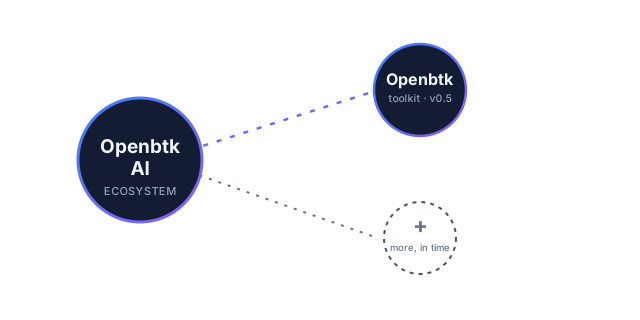
Openbtk AI is an open source project for biomedical AI — built around Openbtk, a real, tested toolkit that ingests, de-identifies, and grounds biomedical data for LLMs. More components will join the ecosystem as they're ready.
One open source ecosystem, one component so far
Openbtk AI is built to give healthcare enterprises, developers, and researchers the open source infrastructure layer biomedical AI still doesn't have.
Openbtk
v0.5 · ActiveDe-identification, streaming pipelines, provenance, EHR loading, retrieval, and guardrails for biomedical AI — tested, benchmarked, and installable today.
Explore Openbtk →What is the Openbtk AI ecosystem?
Openbtk AI is an open source project, not a product lineup — a growing collection of tools for biomedical AI that share one goal: help healthcare enterprises, developers, and researchers build next-generation GenAI applications without re-solving the same infrastructure problems. Openbtk is where it starts.
What that actually solves, in a traditional biomedical AI or agent build:
Build AI your compliance team approves
Patient data is de-identified before it ever reaches a model — so your team can build clinical chatbots and assistants without becoming PHI-handling experts first.
Answer "prove it" before it's asked
Every AI pipeline leaves a verifiable record of what happened — the audit trail enterprise healthcare organizations, auditors, and regulators expect, without extra engineering work on your side.
AI that reads a chart like a clinician
A patient's history, assessment, and plan stay together instead of being scrambled into generic text fragments — so your RAG system gives grounded, coherent answers.
From pilot to enterprise scale, no rewrite
Built to handle real patient-record volumes from day one, so a proof-of-concept with a few hundred notes doesn't turn into a rebuild six months later.
Real documentation, generated from the code
Openbtk's docs build straight from the codebase and deploy automatically on every change — installation, API reference, guides, and benchmarks.